
Tamil Nadu politics has been distinctly different from other Indian states’ politics for over 100 years. Leaders such as Natesa Mudaliar, Soundara Pandiyanar, T. M. Nair, P. T. Rajan, and Sir P. T. Thiagaraya Chetty, founded movements like the South Indian Dhravida Welfare Association and the Justice Party, based on a non-Brahmin identity. These evolved into the Dravidian movement, gaining momentum under this identity. Ideological political movements like the DK and the DMK emerged strongly. Though the Dravidar Kazhagam did not directly engage in electoral politics, its influence on social progress remains evident through ongoing discussions on Dravidian ideology.
The core aim of the Dravidian movement has always been “everything for everyone” and a strong opposition to a specific community’s dominance, which shaped their political journey. The main ideological stance was anti-Brahminism. Conversely, parties like the Bharatiya Janata Party (BJP), the Janata Party, and Congress were seen as Brahmin-supporting factions, with the Dravidian movement opposing them since the 1980s.
The Dravidar Kazhagam never engages in politics in alliance with the BJP. Though the DMK briefly allied with the BJP from 1999 to 2004 under a minimum common program, it was considered an unnatural alliance. Despite DMK leader Karunanidhi’s statement that “the BJP is a bad party, but Vajpayee is a good person,” Vajpayee declined the endorsement, revealing the strained relationship between the DMK and BJP leaders. Towards the end of Vajpayee’s tenure, Karunanidhi’s relationship with him became tighter, driven by the DMK’s opposition to Brahmin ideology.
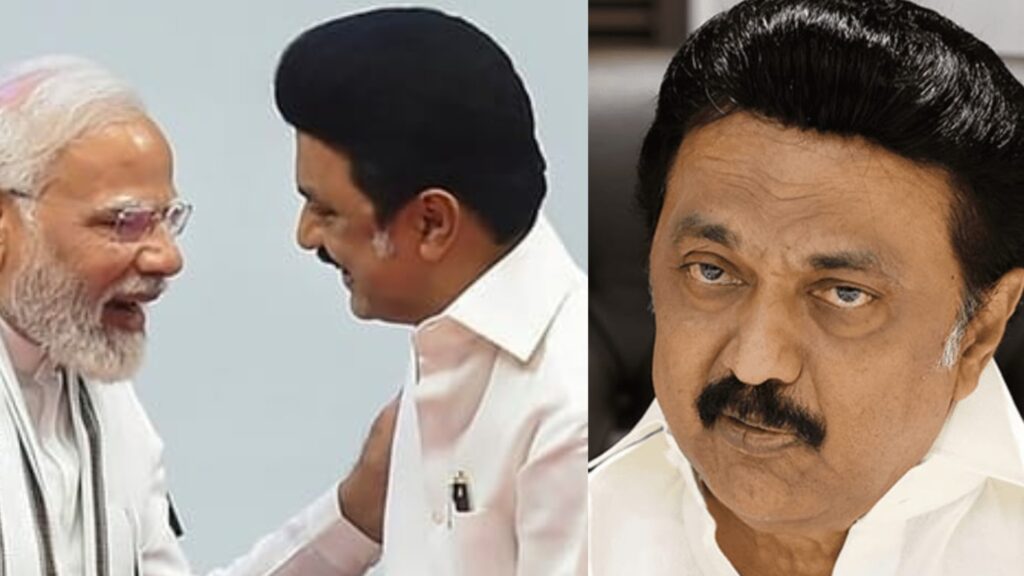
Interestingly, despite the anti-Brahmin stance, the current leadership of the Dravidian movement perceives Modi’s non-Brahmin identity similarly to how Kamarajar supported Congress after leading it. Modi, as a non-Brahmin leader, was personally respectful towards Karunanidhi, even seeking his blessings and visiting him when he was ill, unlike with other leaders like Jayalalithaa. This “soft corner” is reflected in the special treatment extended to Chief Minister Stalin during his visits to Delhi.
Under the leadership of the late journalist Kosalram, political analyst Ravindran Duraisamy is credited with playing a key role in the behind-the-scenes politics that helped the DMK. After Jayalalithaa’s death, during a politically turbulent time when Sasikala was poised to take over the AIADMK, Ravindran Duraisamy used his RSS connections to dismantle Sasikala’s political aspirations, which ultimately benefited the DMK. Although the DMK gained from Sasikala’s imprisonment, it did not want to lose its hold over Dalit, Muslim, and Christian votes (15%) due to BJP’s communal politics, but maintained a soft corner for Modi.
Ravindran Duraisamy consistently conveyed to Modi’s camp that in case the BJP faced internal power struggles, the DMK might support Modi based on his non-Brahmin identity. This explains why, everytime Chief Minister Stalin visits Delhi, he is accorded respect by the Prime Minister. According to Delhi political circle, Modi is unlikely to take any major action against the DMK, as Ravindran Duraisamy continues to assert that Stalin will remain a powerful leader in Tamil Nadu for the next decade.
“Whatever it is? Let the politics happens…Let the governance happens…”
Dhravida Jeeva